Offer
Provide additional details about the offer you're running.
FLASHSALE


Typhoid fever is one of the biggest threats to people’s health in areas that lack proper sanitation and clean water supply. Typhoid fever is an infection made from the bacterium Salmonella Typhi and may cause severe complications if untreated. Typhoid fever affects more than 9 million people annually, with particularly high rates in low- and middle-income countries in Asia, Africa, and some parts of Latin America.

Thus, the severity of the manifestations of typhoid fever is unavoidable, but early diagnosis and appropriate treatment make it possible. Most patients who receive appropriate treatment are likely to be discharged and do not develop any severe consequences of the disease. The Widal test, a test that is used to detect antibodies formed against the bacteria that causes typhoid fever, is central in diagnosing this infection. Nonetheless, recognizing when to get a widal test and identifying the first signs of typhoid fever can make a big difference between an early treatment and a severe sickness.
This will be a detailed article on what the meaning of typhoid fever is, how it is acquired, what signs to look out for, and when one should consider taking a test, especially the Widal test. It will also discuss the shortcomings of the Widal test as well as the role of clinical acumen in the diagnosis and management of the conditions.
Typhoid fever is an acute systemic febrile healthcare illness that results from an infection with the bacterium Salmonella enterica serotype Typhi, also known as Salmonella Typhi. It can be categorized as an enteric fever, a general term for diseases that target the digestive tract and other parts of the body as well. Typhoid and paratyphoid fevers come under enteric fever, the latter being caused by the bacteria Salmonella paratyphi.

Salmonella Typhi gets into the body through the mouth, penetrates the intestinal tract, reproduces, and circulates in the bloodstream to the liver, spleen, and bone marrow. The bacteria incubate within the human body’s immune cells—macrophages—leading to systemic infection and inflammation.
If typhoid enteric fever is not treated, it can cause big problems. The intestines can get holes. There can be bleeding. Organs can stop working. Without help, 30 out of 100 people may die. But with medicine, only 1 out of 100 people might die. This is why it is important to know the signs early. Getting tested with the Widal test can help you get treatment in time.
Typhoid fever is an infection caused by Salmonella Typhi and is mainly spread through contaminated food or water. This contamination is usually a result of bad hygiene, poor handling of foods, and water that has not been treated well. The bacteria can persist in the pond for considerable periods of time in water or sewage, and therefore, the geographical regions that do not effectively control pollution are frequent diseases.
Transmission can occur via:
When water sources are polluted with sewage that harbours Salmonella Typhi or food is prepared by a cook who is a chronic carrier with no clinical signs of the disease, the infection can easily be transmitted. The oral-fecal route is common, and contaminated street foods are easily caught due to a lack of good hygiene practices in endemic regions.
Knowledge of transmission modes for effective prevention and control is crucial, especially in regions where typhoid is more prevalent. Measures such as treating water, proper handling of foods, and washing hands can greatly minimize the spread of the virus.
Typhoid enteric fever usually begins 1 to 3 weeks after ingestion of Salmonella Typhi bacteria. In case the infection is not treated, the disease goes through certain stages where the symptoms are aggravated. It is important to note that such symptoms can be corrected if detected early so that the patient does not have to suffer additional health complications as a result of the said diseases. Here, we present the usual initial signs and how they manifest as the disease progresses in the later stages.
Now, let’s know what the common symptoms of Typhoid fever are:
Typhoid fever is also characterised by a high, persistent fever, which is one of the distinctive features of the disease. While fever is present in many viral infections early into the disease and usually hits a high within the first few days, typhoid fever has a distinguishable “stair-step” pattern. The fever starts from about 38 °C or 100.4 F and rises progressively every day by 1-2 degrees, though it peaks at 40 °C or 104 F at the end of the first week. This raised temperature is generally in the form of a sustained fever with symptoms such as sweating and chills. Prolonged fevers may take 3-4 weeks to develop without appropriate treatment while other symptoms continue to worsen.
Stomach aches are one of the initial symptoms of typhoid fever. This sort of pain usually starts in the lower abdomen, specifically around the belly button area, and can be quite bearable at the initial stage. During the advancement of the infection into the other parts of the system, the pain may increase and result in cramps and the area becoming tender. Patients may feel fullness and swelling due to the inflammation caused by the bacteria settled in the intestines.

Abdominal complications are frequent in typhoid fever but can be in different forms. It may also cause diarrhea, which is the passage of loose and frequent motions that are greenish in color due to bile. This is more demonstrated in children. On the other hand, adults are more susceptible to developing constipation, and this may take several days. In view of this, the fluctuating and diverse signs and symptoms affecting the gastrointestinal system make clinical diagnosis of typhoid fever all the more challenging.
People infected with typhoid fever experience a constant and pulsating headache. The pain is in the frontal region, and the condition generally lasts for several days.
With the increasing severity of the infection, the body’s stores of energy are used up as the immune system continues to fight the bacteria. Some of the symptoms included severe exhaustion to the extent that the patient is immobile, muscle weakness, and a general lack of strength to carry out daily activities. Feeling very weak is made worse by the high fever and loss of appetite that often comes with typhoid fever.
A rash called “rose spots” is seen in some people. These rashes are small, flat, pink patches on the chest and belly. It is important for doctors to notice a rash, but not everyone gets it. It only stays for a few days.
Nausea and vomiting are common symptoms of typhoid fever. This can make dehydration worse, especially if the person also has diarrhea.
A dry cough that doesn’t produce mucus is seen in many people suffering from typhoid fever. This can happen early in the illness and may be a sign of infection.
The fever is low in the beginning and slowly gets higher. The person may also have headaches, feel tired, and have stomach pain.
The fever is high. The person may develop diarrhea or be constipated. They feel very tired and may become confused.
The third week is the time to be concerned. There may be bad problems like holes in the intestines, heavy bleeding, or brain issues.
After the third week, people suffering from typhoid fever slowly start to feel better. But they may still feel tired for many weeks after.
The Widal test is one of the serological tests that have proved to be most effective in the diagnosis of typhoid fever. It identifies antibodies against Salmonella Typhi O (somatic) and H (flagellar) antigens in the serum of the tested individual. Widal test’s time is very critical in determining whether the test will be accurate or not; therefore, timing is important for the test.

However, the Widal test is most reliable after one week of the onset of symptoms. The reason is that there is a delay in the development of an immune response and the production of antibodies that are measurable in the blood. Usually, by the second week, attenuation of the disease is observed with observable antibodies in the affected patients. There is always a danger in testing early because the antibodies may still have a low tire, and thus, there may be a false negative result.
According to the doctors’ advice and the patient’s current age, it is recommended that the patient undergo the Widal test after one week when the patient has had persistent fever, abdominal pain, and other early symptoms. By this time, the body will have produced enough antibodies for the Widal test to detect it after several days of the specific infection. It is also important not to delay the test to more than the second week due to the fact that once the second week is over, the antibody titers begin to rise slightly.
It is important to consult a physician before going through the Widal test to diagnose typhoid fever. Your doctor will know about your symptoms and history of the disease, and will also go for a risk assessment to decide if testing is safe. In places where typhoid fever occurs frequently, or if the patient has had prior contact with germs that cause the disease (for instance, they have recently traveled to a country with high susceptibility rates), the doctor may prescribe early identification tests such as blood culture, stool testing, and the Widal test.
People in higher-risk groups for typhoid fever should be especially inclined to get tested. These groups include:
Travelers: People who have visited areas that have higher rates of the disease within the last several years, including South Asia, Southeast Asia, Africa, and Latin America, should be on the lookout for symptoms and consider testing.
Healthcare workers: Healthcare workers are at higher risk of getting typhoid if they work in areas with typhoid outbreaks. This is especially true if they touch patients' poop or pee.
Food handlers: Food handlers are also at risk if they work in places with poor cleanliness.
If you are in one of these groups, even small signs like fever, belly pain, or stomach problems mean you should see a doctor right away and get tested.
The Widal test measures the presence and levels of two types of antibodies: The strains produce agglutinogens against the somatic O antigen and the flagellar H antigen of Salmonella Typhi. These are antibodies that the body, in a natural manner, produces when the individual gets infected.
O antigen is one of the constituents of the cell wall of S.Typhi and acts as an antigen in infection. While antibodies against all other antigens of the bacterium are found in humans, AGP in the blood shows signs of active infection when it reacts with the O antigen.
The H antigen is a part of the flagella, tail-like structures that allow the Salmonella Typhi to swim. Mean antibody titre and percentage of positivity for the H antigen are high in later stages of infection and may imply past infection with the bacteria or active TB.
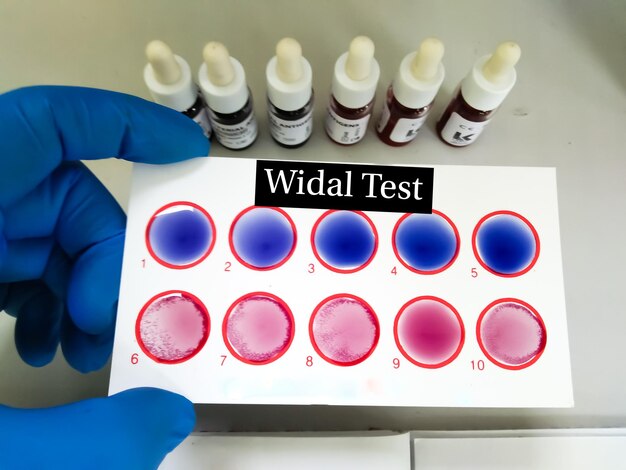
The Widal test is of serological type, which implies that the disposition of the patient’s blood serum is tested for the presence of specific antibodies. The test is typically performed as follows:
Blood Sample Collection: A blood sample is taken from the patient, most preferably an intravenous sample from a vein in the arm.
Antibody Detection: The blood specimen is matched with test antigens, that is, O and H antigens, in a test tube in a laboratory. When a patient has had contact with Salmonella typhi, then his/her blood should agglutinate test antigens due to the presence of antibodies.

Titer Measurement: The results of the Widal test are expressed as titers and are indicative of the degree of dilution of the tested serum that still produced agglutination. For example, a titer of 1:160 means that agglutination happens even if the serum is diluted 160 times.
It is, therefore, important for the interpretation of the Widal test to have knowledge of the clinical background of the patient and his or her area of origin. Chronicity of Salmonella Typhi in endemic areas makes it common to have backgrounds of antibody positivity among presumably healthy individuals, making diagnosis a challenge.
A big increase in antibody levels, like from 1:80 to 1:320, is a better sign of typhoid than just one high result. Levels of 1:160 or higher can mean typhoid in areas where it is common. However, doctors need to be careful because other bacteria or vaccines can cause false results.
The Widal test has been used for many years, but it has some problems. It can sometimes show wrong results.
A positive result for the Widal test is when the patient finds antibodies even when the patient does not have the disease, which is referred to as a false positive. This could be in a person who has been immunized with vaccines for typhoid or someone who has been infected in the past by other species of Salmonella apart from Salmonella Typhi. They are more frequent when extensive coverage of typhoid vaccination has been practiced or in regions where other enteric pathogens dominate.

False negative is a scenario whereby the test comes up negative while the patient is actually suffering from typhoid fever. This can occur if the test is done before the disease has developed enough antibodies that can be detected in the body fluids. Also, immunocompromised persons are at risk of a low immune response and may not produce significant amounts of antibodies to be detected by most tests, hence a false negative.
The main drawback of the Widal test is that it gives a cross-reaction when there are antibodies to other Salmonella species and other gram-negative bacteria like E.coli. This may cause false positive results, particularly in areas where several types of enteric infections may prevail.
Widal test interpretation depends on several factors, including the laboratory conducting the test, geographic location, and the antigens used. It is crucial to mention that there is no steadfast practice regarding the criteria applied in defining a positive outcome and distinguishing between a positive and a negative result in the molecular analysis, which might contribute to differences in diagnosis in various healthcare centres.
Given the limitations of the Widal test, healthcare providers may use other diagnostic methods to confirm a case of typhoid fever. Some of the most common methods include:
Blood cultures are regarded as one of the most accurate types of diagnostic tests for typhoid fever. A blood sample is obtained and placed in a nutrient agar plate so that if there are any Salmonella Typhi, this will then be able to replicate and be identified. This method tests for the bacteria themselves, offering the exact diagnosis of the type of bacteria causing the infection. Nonetheless, blood cultures are positive only 40–80% of the time, particularly if antibiotics have indeed been given previously.
If the blood cultures are negative but typhoid fever is highly suspected, then Bone Material Culture may be carried out. Bone marrow cultures work better than blood tests. They can find the Salmonella Typhi bacteria, even if someone has already taken some antibiotics.

In later stages, typhoid bacteria might be in the patient’s poop or pee. Doctors can test these, but they aren't as good as blood or bone marrow tests.
PCR is a special test that finds the DNA of the Salmonella typhi bacteria in the blood or poop. It is very good at finding the bacteria but costs a lot of money and isn't available everywhere. It’s mostly used in big labs or for research.
Typhoid fever is a dangerous illness that can make people very sick, especially in places with poor sanitation and no clean water. Early diagnosis and treatment are very important to prevent serious problems and deaths. While the Widal test is helpful, it has some problems, and other tests like blood cultures or PCR might be needed.
Vaccination, clean water, good sanitation, and washing hands can help stop typhoid from spreading. By knowing the early signs of typhoid fever and getting tested quickly, people can protect themselves and help stop this disease from spreading.
The best time for a Widal test is in the second week of fever.
A rise in antibody levels (titers) suggests typhoid infection.
The Widal test confirms typhoid fever.
A high, slowly rising fever is one of the first signs of typhoid.
The starting stage of typhoid has fever, headache, and tiredness.
* Medical Disclaimer - The following information is for educational purposes only. No information provided on this website, including text, graphic, and images, are intended as substitutes for professional medical advice. Please consult with your doctor about specific medical advice pertaining to your condition(s).