Offer
Provide additional details about the offer you're running.
FLASHSALE


Time to read 10 min
Table of contents
A whole spine MRI is a single non-invasive scan that images the cervical, thoracic, and lumbar spine together to detect disc herniation, spinal stenosis, nerve compression, tumors, infections, and fractures. Doctors recommend it for widespread or unclear spinal symptoms, suspected cancer spread, or multi-level nerve issues. MyDiagnostics performs whole spine MRI scans with same-day scheduling.
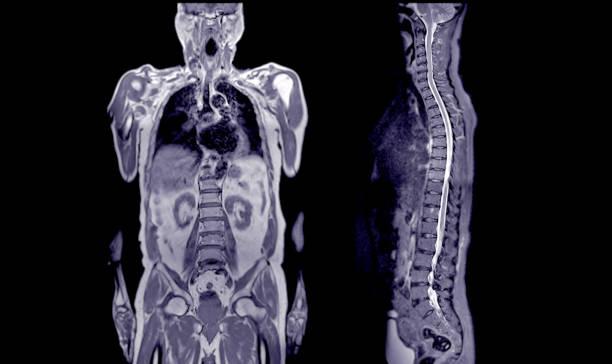
A whole spinal MRI is a detailed imaging scan that covers all three major sections of the spine: the cervical spine (neck), thoracic spine(mid-back), and lumbar (lower back) regions. This diagnostic procedure provides images of the vertebrae, discs, spinal cord, nerves, and surrounding soft tissues.
Unlike a targeted lumbar MRI, which examines only the lower back, a whole spine MRI provides a comprehensive view of the entire spinal column. It is non-invasive and does not use ionizing radiation, unlike X-rays and CT scans.
A whole spine MRI usually takes 45–90 minutes, depending on the protocol and whether contrast is required. At MyDiagnostics, you can book MRI scans and receive your diagnostic report digitally. MRI reports are typically available within 2 to 3 hours.
MRI screening uses a strong magnetic field and radio waves to create detailed images of the spine. You lie on an MRI table, which moves through the scanner while images are captured. You need to remain still during the scan.
Without contrast: Commonly used for evaluating discs, nerves, the spinal cord, and degenerative changes.
With contrast: A gadolinium-based contrast agent may be used when doctors need to assess conditions such as tumors, infections, inflammation, or postoperative changes.
The total whole spine MRI scan time is typically 45–90 minutes, depending on the imaging protocol and whether contrast is used.
A whole spine MRI can identify abnormalities affecting the vertebrae, discs, spinal cord, nerves, and surrounding tissues. Common conditions include:
Disc bulges and herniation: When a spinal disc bulges or its inner material pushes through the outer layer, potentially irritating nearby nerves.
Spinal stenosis: Narrowing of the spinal canal or nerve passageways, which can put pressure on the spinal cord or nerves.
Nerve compression: Pressure on a spinal nerve or nerve root that may cause pain, numbness, tingling, or weakness.
Tumors and metastases: Abnormal growths in or around the spine, including cancer that has spread to the spinal bones or other spinal structures.
Spinal infections: Infections affecting the vertebrae or discs, such as spondylodiscitis, which can cause pain and inflammation.
Fractures and trauma: Injuries to the vertebrae or spinal structures following accidents, falls, or other trauma.
Demyelinating lesions: Areas of damage to the protective covering of nerve fibers, which may be seen in conditions such as multiple sclerosis.
Congenital abnormalities: Structural differences in the spine that are present from birth.
A whole spine MRI may be preferred when:
Multiple spinal levels may be affected: Useful when disease is suspected in more than one region.
The source of symptoms is unclear: Helpful when pain, numbness, or weakness cannot be linked to a specific spinal region.
Cancer staging is required: It can help assess whether cancer may have spread to different parts of the spine.
Symptoms involve multiple limbs: Imaging the entire spine may help assess possible multi-level nerve or spinal cord involvement.
The American College of Radiology (ACR) notes that the choice between targeted and complete spine MRI depends on the clinical question, and complete spine MRI can be useful when multifocal disease is suspected.
A whole spine MRI may be recommended when symptoms or medical history suggest that more than one part of the spine could be involved. It may be useful for:
Widespread or unexplained back and neck pain: When symptoms cannot be linked to one specific spinal region.
Symptoms affecting both arms and legs: May help assess possible spinal cord or multi-level nerve involvement.
Suspected cancer spread: Can help evaluate the spine when metastatic disease is suspected.
Spinal infections: Useful when infection may involve multiple spinal levels.
Multiple sclerosis or other demyelinating conditions: MRI can help identify lesions affecting the spinal cord.
Multiple spinal injuries after trauma: May be considered when injuries are suspected at different levels.
Pre-surgical planning: Provides an overall view of spinal alignment and abnormalities when required for surgical planning.
A single-region MRI, such as a lumbar MRI, may be sufficient when:
Pain or symptoms are clearly localized to one spinal region.
Symptoms suggest involvement of a specific spinal level.
There is no clinical suspicion of multi-level disease.
A focused scan is more appropriate based on the patient's symptoms and history.
A targeted MRI is generally quicker and less expensive than imaging the entire spine. The choice between a whole spine and single-region MRI should ultimately be based on the referring physician's clinical assessment.
A whole spine MRI can be performed with or without contrast, depending on the suspected condition and the doctor's recommendation.
Without contrast: Often sufficient for assessing disc bulges, herniation, spinal stenosis, nerve compression, fractures, and many degenerative changes.
With contrast: A gadolinium-based contrast agent may be injected intravenously to make certain abnormalities more visible. It can help highlight tumors, active infections, inflammation, and postoperative changes.
Feature |
Whole Spine MRI Without Contrast |
Whole Spine MRI With Contrast |
|---|---|---|
What it means |
MRI images are taken without an injected contrast agent. |
MRI images are taken after administering a gadolinium-based contrast agent through a vein. |
Common uses |
Disc bulges, herniation, spinal stenosis, nerve compression, fractures, and degenerative changes. |
Helps evaluate tumors, active infections, inflammation, and postoperative changes. |
What it highlights |
Provides detailed images of the vertebrae, discs, spinal cord, and nerves. |
Makes certain abnormal or active tissues more conspicuous on MRI. |
Is contrast always needed? |
No. Many routine spine MRI examinations can be performed without contrast. |
No. Contrast is added only when clinically indicated. |
Safety |
No contrast-related risks. |
Generally well tolerated, but requires assessment of factors such as kidney function and previous contrast reactions. |
Scan time |
Usually shorter. |
May take longer because additional images are required after contrast administration. |
Who decides? |
Based on the clinical indication and MRI protocol. |
The referring doctor and radiology team determine whether contrast is appropriate. |
Gadolinium contrast is generally well tolerated, but it may not be suitable for everyone. Patients should inform the imaging team about kidney problems, previous reactions to MRI contrast, pregnancy, or other relevant medical conditions. The need for contrast should be assessed before the scan.
At MyDiagnostics, whether contrast is required is determined based on the clinical indication, doctor's prescription, patient history, and the MRI protocol. Contrast is not routinely required for every whole spine MRI.
A whole spine MRI is a non-invasive procedure and usually requires little preparation. Knowing what to expect can make the experience more comfortable.
Before the scan: Metal objects must be removed before the MRI scan. Inform the MRI team about any implants, metal fragments, medical conditions, or previous reactions to contrast. Follow the specific preparation instructions provided for your appointment.
During the scan: You will lie on the MRI table, which moves through the scanner. The machine makes loud tapping and buzzing sounds, so earplugs or headphones are typically provided. Staying still helps ensure clear images.
If you feel claustrophobic: Let the technologist know before the scan. They can explain the procedure and help you remain comfortable throughout the examination.
How long does it take? A whole spine MRI commonly takes around 45–90 minutes, depending on the imaging protocol and whether contrast is required.
After the scan: Most patients can return to their usual activities on the same day. If contrast has been administered, follow the instructions provided by the imaging team.
Getting your report: After the images are reviewed and reported, your results can be shared digitally, making it convenient to access and share them with your doctor. MyDiagnostics provides digital reporting for its diagnostic services.
Tip: MRI preparation can vary depending on the scan protocol and whether contrast or sedation is involved, so always follow the instructions provided when you book your appointment.
Booking a whole spine MRI is straightforward, but whether you need a referral depends on the diagnostic centre, local requirements, and the clinical situation. Since MRI is a medical imaging test, it is best to have the scan recommended by a qualified doctor who can determine whether imaging the entire spine is appropriate.
Get a medical recommendation: Your doctor can determine whether you need a whole spine MRI or a targeted scan based on your symptoms and medical history.
Book through MyDiagnostics: Choose the required MRI service, provide your details, select an available appointment, and complete the booking process. MyDiagnostics offers online booking for its diagnostic services.
Check the whole spine MRI cost:The whole spine MRI cost depends on factors such as the imaging protocol, whether contrast is required, the diagnostic centre, and location. MyDiagnostics notes that MRI pricing varies based on the body part and use of contrast.
Check insurance coverage: Insurance coverage for an MRI depends on your individual policy and whether the scan is medically indicated. Check with your insurer before booking if you plan to claim reimbursement.
After receiving your report: Share the MRI findings with the doctor who recommended the scan. Your doctor can interpret the results alongside your symptoms and decide whether further tests, treatment, or specialist consultation is needed.
If you are unsure whether you need a whole spine MRI or a single-region scan, consult your doctor before booking.This can help ensure you get the right scan without unnecessary imaging or expense.
A whole spine MRI can detect abnormalities across the cervical, thoracic, and lumbar spine, including disc herniation, spinal stenosis, nerve compression, fractures, spinal infections, tumors, and spinal cord abnormalities.
A whole spine MRI may be recommended when symptoms are widespread or difficult to localize, multiple spinal levels may be affected, or conditions such as spinal metastases, infection, or spinal cord disorders are suspected.
No, not always. Many spine MRI examinations can be performed without contrast. Gadolinium contrast may be recommended when doctors need to evaluate tumors, infection, inflammation, or certain postoperative changes.
A whole spine MRI usually takes about 45–90 minutes, depending on the imaging protocol and whether contrast or additional sequences are required.
No. A whole spine MRI is generally painless and non-invasive. You simply need to lie still while the scanner captures images. The MRI machine can be noisy, so earplugs or headphones are usually provided.
Yes. A whole spine MRI can detect spinal metastases, or cancer that has spread to the vertebrae or surrounding spinal structures. Whole-spine MRI is specifically recommended in certain cases where spinal metastases are suspected.
A doctor's recommendation is advisable, particularly when the MRI is being performed to investigate symptoms or a known medical condition. MyDiagnostics provides online diagnostic test scheduling, but the appropriate MRI protocol should be based on clinical assessment.
Yes, a whole spine MRI is generally more expensive than a single-region MRI because it images the cervical, thoracic, and lumbar spine. The exact whole spine MRI cost depends on the imaging protocol, diagnostic centre, location, and whether contrast is required.
Insurance may cover a whole spine MRI when it is medically indicated, but coverage depends on your insurance policy, provider, and pre-authorization requirements. Check with your insurer before booking if you plan to claim reimbursement.
Same-day MRI reports may be available depending on the diagnostic centre and reporting workflow. At MyDiagnostics, MRI reports are typically available within 2–3 hours, subject to the scan protocol and radiologist reporting process.
No. A whole spine MRI does not use ionizing radiation. MRI uses a strong magnetic field and radio waves to produce images. This differs from X-rays and CT scans, which use ionizing radiation.
Medical Disclaimer: This information is for general informational purposes only and does not constitute medical advice, diagnosis, or treatment. The need for a whole spine MRI, including the use of contrast, should be determined by a qualified healthcare professional based on your individual medical history and symptoms. Always consult your doctor and discuss your MRI results with a qualified radiologist or healthcare provider.