Offer
Provide additional details about the offer you're running.
FLASHSALE


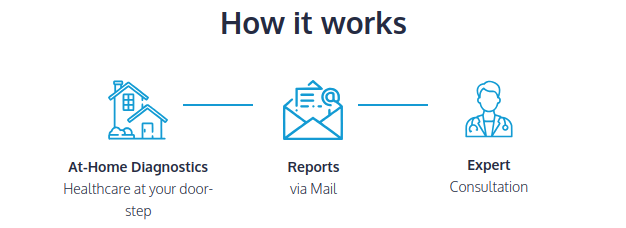
Book a CGM machine in Chennai with MyDiagnostics, the Abbott FreeStyle Libre Pro 14-day sensor for ₹4,999, including home application, removal and a online report. The sensor on your upper arm records glucose every 15 minutes around 1,344 readings over 14 days without routine finger pricks. Your report arrives within 24 hours of removal.
Important: This is a 14-day professional glucose-monitoring service, not a personal CGM that you keep and use to view live readings. FreeStyle Libre Pro is blinded, so readings are downloaded after sensor removal for report analysis. Continue any finger-prick blood glucose checks your doctor has prescribed.
The MyDiagnostics 14-day CGM service costs ₹4,999 in Chennai.
One Abbott FreeStyle Libre Pro sensor for up to 14 days of glucose monitoring.
Home sensor application by a trained healthcare practitioner.
Home sensor removal as part of the service.
A doctor-reviewed glucose report, with delivery within 24 hours of sensor removal.
Booking assistance and appointment coordination for eligible Chennai localities.
The service price covers the listed sensor, application, removal and report. Confirm the final inclusions and appointment availability when booking.
Book the 14-Day CGM Service – ₹4,999
MyDiagnostics offers a 14-day professional CGM service in selected Chennai localities, with practitioner-assisted home application, sensor removal and a doctor-reviewed report.
Home application: A trained healthcare practitioner applies the sensor at your home, subject to appointment availability.
14-day monitoring: The sensor records glucose data every 15 minutes, including overnight patterns.
Report after removal: The recorded data is downloaded for review, with the report delivered within 24 hours of removal.
The FreeStyle Libre Pro is a blinded professional CGM. It does not provide live glucose readings or low-glucose alerts to the wearer. If you need real-time readings, explore the Abbott FreeStyle Libre CGM product page and confirm which personal CGM model and features are available.
Book your home appointment in Chennai: Call MyDiagnostics at 080-4716-6161 to check availability and service coverage.
Home CGM appointments are available in selected Chennai localities, subject to confirmation. Areas to check include:
Anna Nagar
T. Nagar
Velachery
Adyar
OMR
Tambaram
Contact MyDiagnostics to confirm coverage for your specific address before booking.
Fasting: Sensor application generally does not require fasting. Follow any separate instructions provided by your healthcare professional.
Clothing: Wear a loose-sleeved top so the upper arm is accessible.
Skin preparation: Keep the application area clean, dry and free from lotions or creams.
Medication: Continue prescribed medicines unless your treating doctor advises otherwise.
Existing monitoring: Continue your prescribed finger-prick checks; the blinded professional sensor does not replace them.
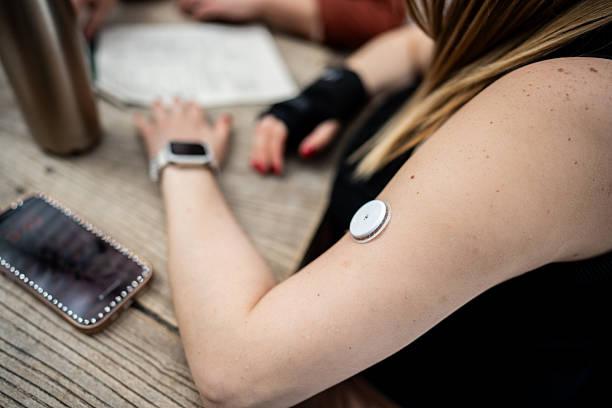
A wearable glucose monitor patch is a sensor worn on the upper arm that measures glucose in interstitial fluid and records glucose patterns over time.
The Abbott FreeStyle Libre Pro sensor records glucose every 15 minutes for up to 14 days, producing up to 1,344 readings over the monitoring period.
A thin filament sits just beneath the skin and measures glucose in interstitial fluid rather than directly measuring blood glucose. Interstitial glucose can lag behind blood glucose, particularly when glucose levels change rapidly.
A trained healthcare practitioner uses a dedicated applicator to insert the sensor filament. The process typically takes less than a minute.
You may feel a brief pinch or mild discomfort during insertion. The sensor avoids repeated finger-prick testing for routine monitoring, but it is minimally invasive rather than completely needle-free.
Your 14-day glucose report summarises glucose patterns, time in range, glucose variability and periods of higher or lower glucose to help your doctor review your diabetes management.
The report may include:
Ambulatory Glucose Profile (AGP): A summary of glucose trends across the monitoring period.
Time in Range (TIR): The percentage of recorded time spent within a specified glucose range.
Time Below Range (TBR): The percentage of time spent below the specified glucose threshold.
Time Above Range (TAR): The percentage of time spent above the specified glucose threshold.
Glucose variability: A measure of how much glucose levels fluctuate.
Average sensor glucose and Glucose Management Indicator (GMI): An estimate derived from average sensor glucose; GMI is not the same as a laboratory HbA1c result.
Daily and overnight patterns: Glucose fluctuations that may be associated with meals, sleep, activity and medication timing when these events are documented.
For many non-pregnant adults with type 1 or type 2 diabetes, the International Consensus on Time in Range recommends spending more than 70% of the time between 70 and 180 mg/dL. Individual targets may differ according to age, pregnancy, health status, treatment and hypoglycaemia risk.
The report helps your doctor interpret glucose patterns alongside your medical history, medication and lifestyle. Do not change insulin or other prescribed medication based on the report without medical guidance.
|
Feature |
FreeStyle Libre Pro professional CGM |
Finger-prick glucometer |
|---|---|---|
|
Measurement |
Glucose in interstitial fluid |
Glucose in a blood sample |
|
Readings |
Up to 1,344 readings over 14 days |
One reading each time you test |
|
Frequency |
Records every 15 minutes |
Depends on testing frequency |
|
Overnight patterns |
Records glucose trends during sleep |
Requires overnight testing |
|
Trends |
Shows glucose patterns and fluctuations |
Provides individual readings; some meters store historical results |
|
Application |
Sensor insertion beneath the skin |
Finger prick for each blood sample |
|
Live readings for the wearer |
No; the professional sensor is blinded |
Displays the result at the time of testing |
|
Cost |
₹4,999 for the listed MyDiagnostics service |
Depends on the meter, strips and lancets |
The two methods serve different purposes. Professional CGM provides a broader record of glucose patterns, while a finger-prick glucometer provides a measurement at the time of testing. The ₹4,999 service price should not be compared using a simple cost-per-reading calculation because the blinded CGM readings are not available for day-to-day use by the wearer.
A 14-day professional CGM test can help a healthcare professional assess glucose patterns and identify periods of higher or lower glucose in people with diabetes.
The FreeStyle Libre Pro is intended for professional glucose monitoring in adults with diabetes. Your doctor can determine whether this service is suitable for your needs.
Type 1 or type 2 diabetes: To assess glucose patterns and possible highs or lows.
Treatment reviews: To help a doctor assess glucose trends when reviewing medication or insulin treatment.
Unexplained glucose fluctuations: To investigate patterns alongside standard clinical assessment.
Prediabetes, PCOS, weight management or athletic performance: Discuss suitability and expected clinical value with your healthcare professional; these uses should not be assumed to be within the device's indicated purpose.
Speak with your healthcare professional before using the sensor if you are pregnant, receiving dialysis, critically ill, under 18, or have an implanted medical device such as a pacemaker. Abbott's applicable product labelling should be checked for the specific population and device.
Remove the FreeStyle Libre Pro sensor before MRI, CT scan, X-ray or diathermy. Follow the product instructions and tell your healthcare team that you are wearing the sensor before any imaging or treatment.
The sensor is designed to record glucose patterns for up to 14 days while you continue your usual daily activities.
Showering and bathing: Generally permitted; avoid rubbing or pulling the sensor.
Swimming: Abbott's published Libre sensor guidance specifies a maximum water depth of 1 metre (3 feet) and a maximum immersion time of 30 minutes. Verify the instructions supplied with the exact FreeStyle Libre Pro model before publishing this specification for the Indian device.
Exercise: Routine activity is generally possible. Heavy sweating, friction and contact sports may loosen the adhesive.
Sleeping: You can generally sleep while wearing the sensor. Avoid pressure or friction that could dislodge it.
Medical imaging and diathermy: Remove the sensor before MRI, CT scan, X-ray or diathermy.
If the sensor loosens or falls off: Do not reinsert it. Contact MyDiagnostics for guidance about replacement eligibility and applicable service terms.
Record meal times, food intake, exercise, sleep, medication timings and symptoms throughout the monitoring period. Your doctor can compare this log with the downloaded report to help interpret glucose fluctuations and guide appropriate management.
Explore these MyDiagnostics resources for further information about glucose monitoring and diabetes testing.
Abbott FreeStyle Libre CGM Sensor – 14-Day Monitoring Service: Learn about the main CGM product and available service options.
HbA1c Test and Diabetes Panels: Learn about laboratory testing for long-term blood glucose management and related diabetes assessments.
Full Body Checkup: Explore broader health screening options, including relevant blood glucose and HbA1c tests.
Blood glucose monitoring and working with your healthcare team: Learn why glucose monitoring and clinical guidance matter.
Symptoms and causes of hypoglycaemia: Understand the signs and potential causes of low blood glucose.
Long-term blood sugar management: Explore evidence-based information on diabetes treatment and ongoing glucose management.


