Offer
Provide additional details about the offer you're running.
FLASHSALE


Time to read 13 min
Table of contents
IgE blood tests and skin prick tests are the two most common methods used to diagnose allergies. They help identify substances that trigger allergic reactions, but neither test is universally superior for every patient or situation. This guide compares IgE blood tests and skin prick tests based on accuracy, safety, cost, and clinical use. Learn which allergy test is best for food allergies, eczema patients, toddlers, penicillin allergy, and those taking antihistamines, so you can make an informed decision with your doctor.
An allergy test helps identify IgE-mediated sensitization, which is commonly linked to immediate allergic reactions. These tests assess how the immune system responds to allergens by measuring the production of specific antibodies, such as IgE.
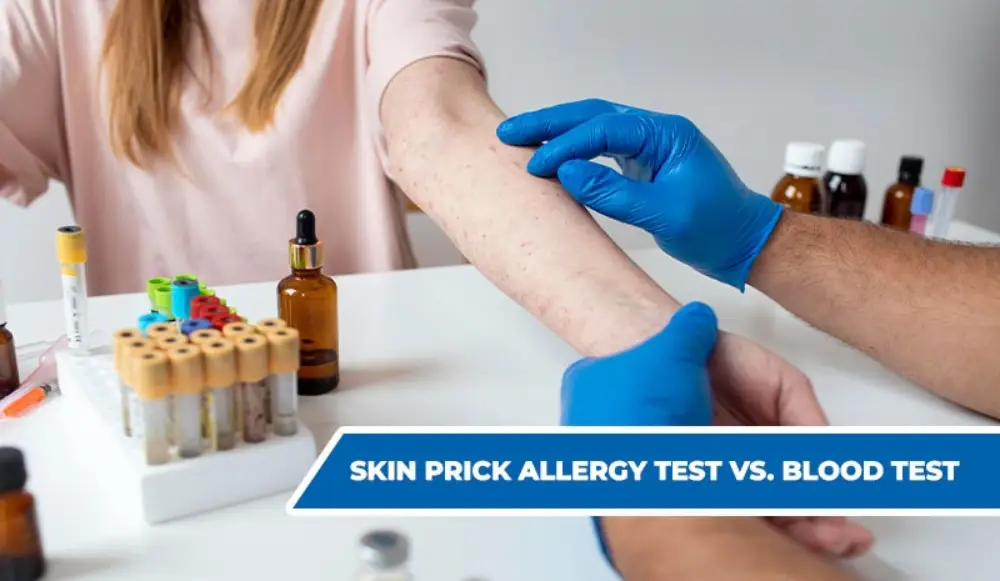
Skin prick tests and IgE blood tests assess this immune response through different biological mechanisms. The testing process for a skin prick test involves applying small amounts of allergens to the skin and observing for a reaction. The IgE blood test, on the other hand, requires drawing a blood sample to measure IgE antibody levels in response to allergens.
A small amount of allergen is applied to the superficial layer of the skin, usually on the forearm or back. If IgE antibodies are present, mast cells release histamine, leading to a raised bump (wheal) and surrounding redness (flare) within 15–20 minutes.
A laboratory test is performed on a blood sample to measure allergen-specific IgE antibodies, reported as numerical values (kU/L).
Both tests measure IgE sensitization rather than confirming a clinical allergy.
Skin tests indicate local mast cell activity
Systemic IgE is detected in the blood tests regardless of skin response
Visual Aid Suggestion
Blood tests can screen for multiple allergens simultaneously, providing a broader overview of potential sensitivities.
Accuracy in allergy testing is not about choosing one universally better test, but about selecting the right test for the right patient and clinical situation. Factors like sensitivity, specificity, and how well the test results match real symptoms all help determine how useful a test is.
Understanding these differences helps prevent overdiagnosis and avoid unnecessary diet or lifestyle restrictions. Accurate diagnosis depends on selecting the appropriate test and interpreting the results in the context of the patient's clinical history.
Skin prick tests have high sensitivity, meaning they are effective at detecting IgE sensitization. These are useful in detecting early or mild IgE sensitization.
Skin prick tests are designed to detect type I allergic reactions, which occur rapidly after allergen exposure. The reaction occurs directly in the skin and reflects immediate mast-cell activation. High sensitivity increases the likelihood of detecting sensitization. However, without symptom correlation, this may lead to false-positive results.
IgE blood tests are usually more specific since they determine the precise amount of allergen-specific IgE antibodies in blood. These numerical results help clinicians assess the degree of sensitization, not just its presence.
Blood tests may be less sensitive than skin prick testing for detecting very mild or localized IgE sensitization, but they offer higher specificity in many clinical scenarios.
An allergy cannot be diagnosed using a test alone, whether skin-based or blood-based. A positive result confirms IgE sensitization but does not necessarily predict real-world allergic symptoms.
A lot of individuals test positive but are able to tolerate the allergen. An allergy diagnosis requires test results to match the patient’s symptoms, timing, and exposure history.
Skin prick tests are highly sensitive for detecting immediate, IgE-mediated allergic reactions. They are very sensitive, hence excellent screening tools and are effective tools to identify allergens responsible for triggering symptoms. Nevertheless, the accuracy decreases when the patient is using antihistamines, has eczema, or has highly reactive skin. Blood tests can give credible results in such instances.
Blood tests are especially helpful when skin tests cannot be done because of medicines, skin conditions, or the risk of severe allergic reactions. They provide clear and consistent results that are not affected by factors like skin thickness or irritation. Blood tests do not require direct allergen exposure, making them suitable for patients at risk of severe reactions or with sensitive skin.
While blood tests may miss very mild allergies, their high specificity makes them valuable for assessing risk and managing allergies over time. They are most accurate when test results are interpreted alongside a person’s symptoms.
Both testing methods offer practical advantages and limitations. Choosing the right one depends on medical history, skin condition, and urgency.
Feature |
Skin Prick Test (SPT) |
IgE Blood Test |
|---|---|---|
Speed |
15–20 minutes |
2–5 days |
Medications |
Must stop antihistamines |
No restrictions |
Safety |
Small risk of reaction |
Zero risk of reaction |
Cost |
Generally cheaper |
Generally more expensive |
Comfort |
Minimal discomfort during the procedure |
Patients with eczema often struggle with standard skin testing due to active inflammation and altered skin reactivity. Contact dermatitis is another skin condition that can complicate allergy testing, as it also involves skin inflammation and can affect test results.
In such cases, a patch test may be used as an alternative method to diagnose contact dermatitis and identify substances causing delayed skin reactions. Patch testing involves applying allergens to the skin with patches and reading the results after several days, making it especially useful for detecting delayed allergic responses.
Inflamed or broken skin may:
Produce false‑positive wheals
Leave no clear area to perform testing
IgE blood testing bypasses the skin entirely. It offers safer, more reliable results in:
Active dermatitis
Chronic hives (urticaria)
Medications play an important role in selecting the appropriate allergy test. Antihistamines do not affect allergen-specific IgE antibody levels measured in blood tests. However, antihistamines directly suppress skin reactions during allergy testing.
Before performing allergy testing, a physical examination is also essential to assess the patient's suitability and overall health. Understanding this difference helps prevent false-negative results and unnecessary repeat testing.
Do I need to discontinue antihistamines in order to do an allergy blood test?
No. There is no interference of antihistamines with the allergen-specific IgE measurement in blood. Blood tests determine circulating antibodies, rather than histamine release and skin reactivity. That is why IgE blood testing is suitable when the patient cannot safely withdraw allergy drugs because of the persistence of symptoms.
Antihistamines act by inhibiting histamine receptors, preventing the skin reaction that is visible, to enable successful skin prick testing. False-negative results may occur when histamine release is suppressed, leading to a reduced or absent wheal-and-flare reaction.
This is why the skin prick tests cannot be used effectively when the antihistamines are in the body. In the majority of cases, antihistamines should be discontinued within 3 to 7 days, depending on the type of medication and its action duration.
Food allergies are normally IgE-mediated and may result in quick, occasionally risky reactions. The appropriate selection of a test is essential.
Different diagnostic tools help identify food allergens and immune responses more accurately. These tests are crucial for pinpointing specific allergens responsible for allergy symptoms. The skin tests and blood tests have their own benefits based on the type of reaction.
Skin prick tests are especially useful when there is a fast-acting food allergy that occurs within minutes of consumption. Peanuts, shellfish, and eggs commonly produce strong wheal-and-flare reactions when IgE antibodies are present and are frequent causes of immediate food allergies.
Since the skin response is very similar to real-life exposure, the outcomes are usually in line with the immediate symptoms, such as the hives, swelling, or difficulty breathing. Nevertheless, even a positive outcome still has to be verified by clinical history to prevent overdiagnosis.
Component-resolved diagnostics are useful because they identify specific allergenic proteins within a food, helping assess the risk and severity of reactions. IgE blood tests permit component-resolved diagnostics. This helps distinguish true allergy from cross-reactivity.
Allergy testing in young children must balance accuracy, safety, and emotional comfort. The results of allergy testing in children are used to develop an individualized treatment plan, which may include allergen avoidance, medications, or immunotherapy based on the diagnosis.
Skin tests include several pricks, which can be painful.
Blood tests involve only one blood draw.
Blood tests are often preferred in toddlers because they require only a single blood draw and avoid multiple skin pricks.
Reduced trauma
No chance of systemic skin reactions.
Improved collaboration in testing.
The use of drugs causes different reactions than other environmental allergies. It happens because drugs have a direct interaction with immune cells in a complex manner.
The evaluation of penicillin allergy, which is a particular allergen, is thus a stricter diagnostic process. In addition to skin prick testing, the intradermal test is also used for penicillin allergy diagnosis, as it can provide more precise results for this specific allergen. Using the wrong test can lead to lifelong mislabeling and unnecessary avoidance of first-line antibiotics.
Skin testing, such as skin prick testing and intradermal testing, is the gold standard of diagnosis of penicillin allergy. These are tests that directly determine the ability of penicillin-specific IgE to activate the mast cells in the skin.
IgE blood tests for penicillin have lower sensitivity compared to skin and intradermal testing and may miss true allergies. It implies that they may not be able to identify real allergies. Consequently, blood tests are not adequate for the exclusion of penicillin allergy.
Although skin testing is very helpful, it cannot be used in all clinical cases. Some disorders may inhibit or falsify skin reactions, and blood testing will be useful as a supplementary method. IgE blood tests can also provide evidence of sensitization, which is not reflected by skin testing.
Skin test reactions can be reduced or hidden by medicines such as antihistamines or corticosteroids. In these cases, blood tests that measure allergen-specific IgE can still detect an allergy. Blood tests are also useful when the immune response affects the whole body rather than just the skin, such as in people with weakened skin immune responses.
Because blood tests are not influenced by skin conditions or medications, they can identify sensitivities that skin tests might miss. However, test results must always be matched with a person’s symptoms to confirm a true allergy.
When comparing allergy tests, cost and turnaround times are important factors, especially for patients trying to plan care or manage symptoms. Both skin prick tests and blood tests reliably detect allergies, but they differ in expense and timing.
Skin prick testing is performed in the clinic during a single visit. It doesn’t require a laboratory to analyze samples, so there are no lab processing fees.
The clinician applies small amounts of common allergens directly to your skin using tiny pricks. The results are usually visible within minutes, so there’s no additional billing for lab work.
Blood tests require your sample to be sent to a lab for analysis.
Costs include the lab fee, specialized equipment, and the technical expertise needed to measure allergen-specific IgE antibodies.
Bottom line on cost:
Skin prick tests tend to cost less upfront because they’re done entirely in the clinic, whereas blood tests involve laboratory analysis that adds to the total expense. You can contact MyDiagnostics for detailed information about available skin allergy testing options.
The biggest advantage of skin prick testing is speed.
You get results during the same visit, typically within 15–20 minutes.
Ideal when an immediate assessment is needed, such as diagnosing seasonal allergies or explaining sudden symptom changes.
After the blood draw, the sample is sent to a lab.
Depending on the lab, weekend timing, and local processing speed, results may take a few days to a week.
Some specialized tests or panels might take even longer.
If you need to adjust treatment quickly, skin prick tests are usually faster. Blood tests require waiting for lab processing.
|
Feature |
Skin Prick Test |
Blood Allergy Test |
|---|---|---|
|
Typical Cost |
Lower |
Higher |
|
Lab Fees |
No |
Yes |
|
Result Speed |
Same visit (minutes) |
Days to a week |
|
Affected by Medications |
Yes |
No |
|
Affected by Skin Condition |
Yes |
No |
Choosing the right allergy test depends on your symptoms, medical history, and current medications. No single test is suitable for everyone. Both tests will work differently for different people according to their symptoms.
Skin prick tests are particularly effective for identifying environmental allergens such as pollen and pet dander. It is important to consult an allergy specialist, who can guide you in selecting the most appropriate test and interpret the results accurately.
You need quick results (usually available within 15–20 minutes)
You can safely stop antihistamines or steroids before testing
You do not have active skin conditions like eczema or psoriasis
You have a low risk of severe allergic reactions
Your symptoms are immediate (such as hives, sneezing, or wheezing after exposure)
You are being tested for environmental allergies, such as pollen allergy
Why it works: Skin prick tests are highly sensitive and are excellent for identifying immediate, IgE-mediated allergies when the skin response is reliable. Skin prick test results are most reliable when the skin is not affected by medications or skin conditions.
You have sensitive skin, eczema, or widespread skin disease
You cannot stop allergy medications
You have a history of severe or anaphylactic reactions
You need safer testing with no direct allergen exposure
You want consistent and reproducible results for long-term allergy management
The allergy response may be systemic, not limited to the skin
Why it works:
Blood tests are unaffected by skin condition or medications and can detect allergen sensitization even when skin testing is unreliable or unsafe. Blood test results can also help guide decisions about allergy shots (immunotherapy) and inform allergen avoidance strategies as part of a comprehensive allergy management plan.
The most accurate allergy diagnosis comes from matching test results with real-life symptoms. In many cases, doctors may use both tests together to get a complete picture and avoid overdiagnosis or unnecessary lifestyle restrictions.
Allergy tests do not diagnose allergies but give supportive evidence. The wrong interpretation may result in unwarranted food avoidance, anxiety or unsafe exposure. Professional skills in the field of medicine make sure that the results are used properly and safely.
An asymptomatic positive test is a sensitisation and not a clinical allergy. Physicians interpret the results based on the history of the patient, the onset of the symptoms, and the exposure patterns in the real world.
This whole-patient approach prevents overdiagnosis and ensures only true allergies are identified. Adequate interpretation generates trust, precision, and evidence-based care.
Note: At MyDiagnostics, allergy testing focuses on clinically validated IgE blood testing, interpreted alongside symptoms and medical history by qualified professionals.
Neither skin prick testing nor IgE blood testing is universally superior. Accuracy depends on the clinical situation, symptoms, and individual patient factors.
Skin tests are fast and highly sensitive, while blood tests are safer, medication-independent, and provide more detailed immune profiling. The two tests are fundamental when combined with medical history and interpreted by a qualified clinician.
Accuracy depends on the allergen, patient condition, and clinical context.
Yes, especially for pollen, dust mites, and pet dander.
Yes, antihistamines do not affect IgE blood test results.
IgE blood tests are often preferred when eczema affects testing areas.
Blood tests avoid allergen exposure and may be safer for high-risk children.
Yes, in cases of medication interference or complex food allergies.
Yes, skin prick tests are generally more cost-effective.
**Medical Disclaimer: The following information is for educational purposes only. No information provided on this website, including text, graphics, and images, is intended as a substitute for professional medical advice. Please consult with your doctor about specific medical advice about your condition(s).