Offer
Provide additional details about the offer you're running.
FLASHSALE


Time to read 13 min
Table of contents
Visceral fat is fat stored deep inside the abdomen around internal organs. Unlike subcutaneous fat, it is metabolically active and is associated with higher risks of insulin resistance, type 2 diabetes, and cardiovascular disease. MRI can provide a detailed assessment of visceral and abdominal fat distribution without ionizing radiation.
MyDiagnostics offers MRI-based assessment of visceral fat as part of its Vital Full Body MRI Scan, which measures the volume of internal fat around organs and provides a more direct assessment than relying on weight or BMI alone.
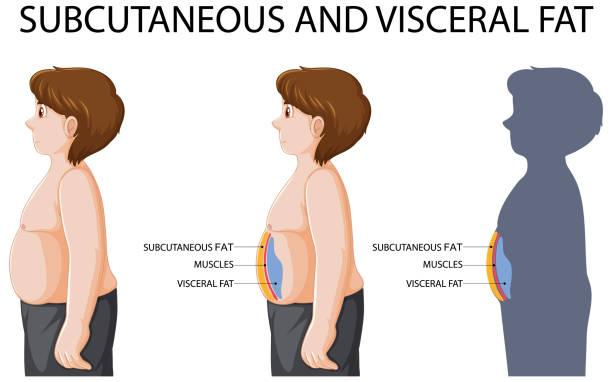
Visceral fat is the fat stored deep inside the abdominal cavity, surrounding internal organs such as the liver, pancreas, and intestines. It is also known as intra-abdominal fat or “organ fat.”
Unlike subcutaneous fat, which sits directly beneath the skin, visceral fat is metabolically and hormonally active. It can release hormones and inflammatory compounds that influence how the body processes glucose, fats, and inflammation. This is why excess visceral fat is considered more concerning for health problems than fat stored only under the skin.
Visceral fat is sometimes called “active fat” because of this biological activity. The term “organ fat” refers to its location around vital abdominal organs.
Understanding why visceral fat matters is important because having excess visceral fat is associated with several metabolic and cardiovascular health risks. However, its amount cannot be accurately determined simply by looking at your waist or belly; specialized abdominal fat measurement including imaging, can provide a more direct assessment.
The difference between visceral and subcutaneous fat is not just their location. They also behave differently in the body.
|
Feature |
Visceral Fat |
Subcutaneous Fat |
|---|---|---|
|
Location |
Deep inside the abdomen around internal organs |
Directly beneath the skin |
|
Also called |
Intra-abdominal or organ fat |
Surface fat |
|
Can you pinch it? |
No, it cannot be directly pinched or felt |
Usually soft and pinchable |
|
Visibility |
Cannot be seen directly |
Often visible around the belly, hips, thighs, or other areas |
|
Metabolic activity |
Highly metabolically active and can release inflammatory compounds |
Primarily functions as energy storage and insulation |
|
How is it assessed? |
May require specialized visceral adipose tissue measurement |
Can be assessed more easily through physical measurements, although exact amounts still require measurement |
The soft, pinchable belly fat you can feel is generally subcutaneous fat. A pinch or visual test cannot tell you how much visceral fat is stored around your organs. This is why waist circumference vs. visceral fat should not be treated as equivalent measurements: waist circumference can indicate abdominal fat accumulation but does not directly quantify visceral fat.
Visceral fat is found inside the abdominal cavity, around and between organs such as the liver, pancreas, and intestines. Higher amounts may contribute to a firmer or protruding abdomen, although belly shape alone cannot determine visceral fat levels.
Unlike soft, pinchable abdominal fat, visceral fat is too deep to see or feel directly. Two people with similar body weight or waist measurements can therefore have different amounts of visceral fat.
If a more direct assessment is needed, imaging-based abdominal fat measurement can be considered. Visceral fat MRIand MRI body composition scans can provide detailed information about abdominal fat distribution and help distinguish visceral fat from subcutaneous fat.
Visceral fat is metabolically active tissue that surrounds internal abdominal organs and can influence inflammation, insulin sensitivity, and metabolic health. Higher levels of visceral fat are associated with an increased risk of conditions such as type 2 diabetes, cardiovascular disease, and metabolic dysfunction.
Even modest weight loss can provide meaningful health benefits. According to the Centers for Disease Control and Prevention (CDC), losing 5% to 10% of body weight can provide meaningful health benefits, including improvements in blood pressure, cholesterol, and blood sugar. The amount of visceral fat lost can vary between individuals.
Body weight or appearance alone cannot determine how much visceral fat you have.Two people with similar BMI or waist measurements may have different distributions of visceral and subcutaneous fat. This is why direct or imaging-based assessment can be useful when a more detailed evaluation of body-fat distribution is needed.
Higher visceral fat levels are associated with several metabolic and cardiovascular health issues including:
Cardiovascular disease: Excess abdominal and visceral fat is associated with increased cardiovascular risk.
Insulin resistance and type 2 diabetes: Visceral adiposity is associated with impaired insulin sensitivity and abnormal glucose regulation.
Chronic inflammation: Visceral adipose tissue can release inflammatory mediators that contribute to low-grade systemic inflammation.
Metabolic dysfunction-associated fatty liver disease: Excess visceral and abdominal fat is associated with metabolic liver disease.
Certain cancers: The CDC reports that overweight and obesity are associated with 13 types of cancer. This association relates to excess body weight and obesity broadly and should not be interpreted as proving that visceral fat alone causes cancer.
Excess visceral fat is closely associated with metabolic syndrome, a cluster of risk factors that can occur together. These may include high blood pressure, elevated triglycerides, abnormal blood sugar levels, and other metabolic changes.
Visceral fat can contribute to insulin resistance and altered lipid metabolism, which may increase the likelihood of developing several of these risk factors at the same time. This clustering is important because having multiple metabolic risk factors can increase the overall risk of cardiovascular disease and type 2 diabetes.
That is why healthcare professionals may assess waist circumference, blood pressure, blood glucose, triglycerides, and other markers rather than relying on a single measurement.
Yes. A person can have a normal BMI or slim appearance while carrying a relatively high amount of visceral fat. This is sometimes described as “Thin Outside, Fat Inside” (TOFI) or informally as “skinny fat.”
BMI measures weight relative to height but does not show where body fat is stored. Similarly, looking at your belly cannot reveal how much fat is located deep inside the abdominal cavity.
This is where body composition analysis and imaging-based visceral fat measurement methods can provide additional information. A visceral fat MRI or MRI body composition scan can assess abdominal fat distribution more directly than appearance, weight, or BMI alone.
There is no single visceral-fat value that is considered healthy for everyone. Reference ranges depend on the measurement method, device, age, sex, population, and calculation method.
Some clinical guidelines use a waist circumference above 102 cm (40 inches) in men and above 88 cm (35 inches) in women as thresholds associated with increased metabolic risk. These are waist-circumference thresholds, not direct measurements of visceral fat, and cutoffs may vary by population.
Therefore, waist circumference can be useful as a practical indicator of abdominal-fat-related risk, but it should not be interpreted as an exact measurement of visceral fat.
Consumer devices may classify visceral fat into categories such as low, elevated, or high. These categories are device-specific and should not be interpreted as equivalent to MRI-derived visceral-fat measurements.
|
Visceral Fat Level |
General Interpretation |
|---|---|
|
Low / healthy range |
Lower estimated visceral fat |
|
Elevated |
May indicate increased visceral fat and metabolic risk |
|
High / higher-risk range |
Greater visceral fat accumulation; further health assessment may be appropriate |
Important: Exact cutoffs vary between visceral fat measurement methods and devices. A visceral fat rating from a consumer body composition monitor should not be treated as equivalent to a measurement obtained through imaging.
For a more direct assessment of abdominal fat distribution, visceral fat MRI and other imaging-based methods can provide detailed information about intra-abdominal fat.
There are several abdominal fat measurement methods, ranging from simple anthropometric measurements to advanced imaging. They differ in what they measure, accuracy, cost, availability, and clinical use.
Waist circumference is a practical screening measure for abdominal fat and metabolic risk, but it does not directly measure visceral fat. Commonly used thresholds for the waist size are >102 cm (40 inches) for men and >88 cm (35 inches) for women in some clinical guidelines, although thresholds may differ for specific populations.
A DEXA scan uses low-dose X-rays to assess body composition and can provide information about regional fat distribution. It offers more information than body weight or BMI alone, although it does not provide the same type of direct visceral-fat imaging as MRI or CT.
CT can directly visualize and quantify visceral and abdominal fat, making it a highly accurate imaging method. However, CT uses ionizing radiation, so radiation exposure is an important consideration when choosing an imaging method for body-composition assessment.
Smart scales that use bioelectrical impedance analysis (BIA) estimate body composition using electrical impedance measurements. Some devices provide a calculated visceral-fat rating. These measurements can be affected by factors such as hydration, food intake, exercise, and time of measurement, so they are best viewed as estimates rather than direct visceral-fat measurements.
MRI can provide detailed imaging of abdominal fat without using ionizing radiation. It can distinguish visceral fat from subcutaneous fat and can be used to quantify fat distribution and volume.
MRI is a highly accurate non-invasive imaging method for assessing abdominal fat distribution and can distinguish visceral fat from subcutaneous fat without ionizing radiation.
A visceral-fat MRI uses magnetic fields and radio waves to create detailed images of the abdomen. It does not use ionizing radiation.
During the scan, multiple images of the abdominal region are acquired. Specialized image-analysis techniques can then distinguish visceral adipose tissue from subcutaneous adipose tissue and calculate the amount or distribution of abdominal fat.
A typical visceral-fat MRI assessment may involve:
Positioning: You lie on the MRI table while the scanner is positioned to capture the required abdominal images.
Image acquisition: The MRI scanner obtains multiple images of the abdominal region.
Fat analysis: Image-analysis software can identify and differentiate visceral and subcutaneous fat.
Reporting: The resulting assessment may include measurements or visual information describing abdominal-fat distribution.
MRI provides direct imaging of abdominal fat distribution without ionizing radiation. This makes it particularly useful when a more detailed assessment is required than can be obtained from BMI, waist circumference, or consumer body-composition scales.
MRI can also provide volumetric information, allowing visceral fat to be assessed more directly rather than estimated solely from external measurements.
For measuring visceral fat directly, the methods can be broadly compared as follows:
|
Method |
What it measures |
Visceral-fat assessment |
Radiation |
|---|---|---|---|
|
MRI |
Direct abdominal fat imaging |
Very high |
None |
|
CT |
Direct abdominal fat imaging |
Very high |
Yes |
|
DEXA/DXA |
Regional body composition |
Moderate |
Low-dose X-rays |
|
Waist circumference |
Abdominal-fat risk proxy |
Indirect |
None |
|
BIA/smart scales |
Estimated body composition |
Estimated |
None |
The cost of a visceral fat MRI scan varies by location, MRI facility, scan protocol, and whether the assessment is offered as part of a broader MRI assessment. These scans may be available through specialty diagnostic centres, preventive-health providers, and advanced health-screening services.
For current MyDiagnostics pricing, scan availability, inclusions, and booking details, check the specific product or booking page before scheduling your scan.
Reducing excess visceral fat generally involves improving overall metabolic health and body composition rather than trying to target belly fat alone.
Prioritize vegetables, fruits, whole grains, fiber-rich foods, adequate protein, and minimally processed foods, while limiting excessive added sugars and highly refined foods.
Regular aerobic activity and resistance training can help maintaining a healthy weight, cardiovascular health, insulin sensitivity, and healthier body composition. The CDC recommends regular physical activity as an important part of chronic-disease prevention and healthy weight management.
Even a 5% to 10% reduction in body weight can provide meaningful health benefits. The CDC notes that modest weight loss can improve factors such as blood pressure, cholesterol, and blood sugar.
The amount of visceral fat lost with weight reduction varies between individuals, so weight change should be considered alongside other health markers and body-composition measures.
Insufficient sleep has been associated with higher visceral-fat accumulation in observational studies. A 2023 analysis of more than 5,000 US adults found an inverse association between sleep duration and visceral fat mass, although the authors noted that prospective and mechanistic research is still needed to establish causality.
Another longitudinal study found that adults aged under 40 who regularly slept five hours or less had greater increases in visceral adipose tissue than those sleeping six to seven hours, although the relationship varied by age.
Insufficient sleep may be associated with greater visceral-fat accumulation. Observational research has found associations between shorter sleep duration and higher visceral fat, but the relationship can be influenced by age, lifestyle, and other health factors.
Consistently inadequate sleep may be associated with greater visceral-fat accumulation, although the relationship is influenced by factors such as age, lifestyle, and overall health.
Your waist measurement or a home body-composition scale can provide useful estimates, but these methods cannot directly measure the amount of visceral fat around your organs.
MRI can provide a more direct assessment of visceral and subcutaneous fat distribution without ionizing radiation. If you want a detailed assessment of abdominal fat distribution, explore the MyDiagnostics Vital Full Body MRI Scanand check the current scan availability, pricing, and booking requirements.
To book a visceral-fat MRI scan with MyDiagnostics, select the relevant scan, choose your preferred appointment, and follow the current booking instructions. The MRI assessment can provide detailed information about abdominal fat distribution as part of body-composition analysis.
Visceral fat is fat stored deep inside the abdomen around organs such as the liver, pancreas, and intestines.
Not exactly. Belly fat can include both visceral fat and subcutaneous fat. Visceral fat lies deeper around internal organs, while subcutaneous fat sits beneath the skin.
Excess visceral fat is metabolically active and can release inflammatory compounds. It is associated with insulin resistance, type 2 diabetes, heart disease, and chronic inflammation.
There is no single healthy visceral fat level for everyone. Reference ranges vary by measurement method, device, age, sex, and population.
Yes. A person can have a normal BMI or slim appearance while carrying excess visceral fat. This is why appearance alone cannot reliably assess visceral fat.
MRI is one of the most accurate non-invasive methods for measuring visceral fat because it can directly visualize and quantify abdominal fat without radiation.
MRI creates detailed images of the abdomen and uses image analysis to distinguish visceral fat from subcutaneous fat and measure its distribution or volume.
MRI provides a more direct and detailed assessment of visceral fat than waist circumference, while DEXA provides an estimate of body-fat distribution. Accuracy depends on the specific measurement method and protocol.
Preparation depends on the MRI protocol and diagnostic centre. Follow the specific instructions provided when booking your scan.
No. Waist circumference can indicate abdominal-fat-related metabolic risk, but it does not directly measure the amount of visceral fat. Imaging methods such as MRI can provide a more direct assessment.
No. MRI does not use ionizing radiation. It uses magnetic fields and radio waves to create detailed images of abdominal tissues and fat distribution.
Reduce added sugars and refined carbohydrates, eat more fiber and protein, exercise regularly, prioritize quality sleep, and manage chronic stress.
You can book a visceral fat MRI scan through MyDiagnostics by checking the available scan, location, appointment slots, and current pricing on its booking page.
Medical Disclaimer: This article is for general educational purposes and does not replace medical advice, diagnosis, or treatment. Visceral-fat measurements should be interpreted in the context of your overall health, medical history, and other clinical risk factors. Consult a qualified healthcare professional if you have concerns about your weight, metabolic health, or test results.